
Buried in the Records
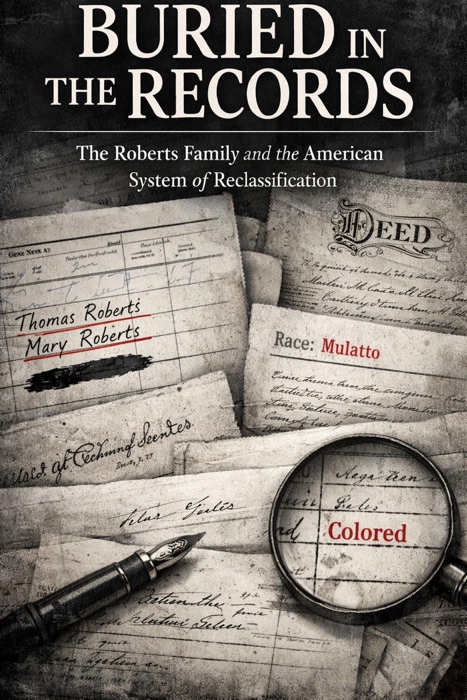
Buried in the Records is a records-first investigation into how families are reclassified, misread, and misunderstood when administrative systems change faster than lived reality.
Focusing on the Roberts family, this book traces land deeds, wills, tax lists, court minutes, census records, institutional rolls, and geographic continuity across generations. The evidence reveals a family living free, early, and persistently—appearing in the American record long before racial categories hardened, and only later being compressed into classifications that failed to reflect their history.
This is not a book built on legend or assertion. Oral history is acknowledged, but it is not treated as proof. Instead, the narrative follows what the records show—and just as importantly, what they do not show. There is no documentation of enslavement, purchase, sale, or emancipation. What emerges instead is a pattern of continuity that resists common assumptions and demands a more careful reading of the archive.
Along the way, the book examines how institutions—schools, churches, registration systems, and censuses—do more than record identity. They reproduce it. Repetition becomes authority. Labels become inheritance. Scholarship later explains what bureaucracy first imposed.
Rather than arguing for certainty where the archive cannot provide it, Buried in the Records models a disciplined approach to historical correction. It reads sources sideways instead of vertically, compares record types in context, and distinguishes lived reality from administrative convenience.
This book is for readers interested in genealogy, Indigenous and African American history, archival research, and the quiet ways identity is reshaped without consent. It does not replace one myth with another. It restores context where the record erased it—and shows how truth can survive even when it is buried.


